20% off £40 or 15% off £30
Manuka honey: what it is, what it does and what MGO and UMF really mean

Written byH&B editorial team

Don’t get the Manuka buzz? Discover this exceptional honey’s benefits and how to choose the right kind for you
Summary
1What’s Manuka honey?
Manuka honey is a special type of honey made by bees who visit the Manuka bush, native to New Zealand.
2What are the potential benefits of Manuka honey?
There's still lots to learn but some potential benefits might include antibacterial properties and wound support.
3What’s MGO in Manuka honey?
MGO is the most coveted ingredient in Manuka honey, thanks to its antimicrobial properties. All natural honey has some antibacterial effects, but scie
Manuka honey: what makes it so fancy? And what do all the acronyms like MGO, UMG and NPA stand for? In this ultimate guide to Manuka, we’ll comb through the details and the potential benefits and help you decide whether it’s worth it...
What’s Manuka honey?
Manuka honey is made by honeybees that collect nectar from the Manuka shrub (Leptospermum scoparium), a plant from the myrtle family. This special honey is classed as monofloral, meaning it comes mainly from one type of flower, and it’s native to New Zealand and South East Australia.1
Known for its rich, earthy flavour, Manuka honey ranges in colour from creamy beige to deep amber. These natural variations come down to factors like how mature the honey is, how it’s produced and processed and how it’s stored. Things like moisture levels and natural sugars also influence its texture, taste and overall character. Manuka honey also naturally contains plant-derived compounds such as phenolic acids and polyphenols, including flavonoids.
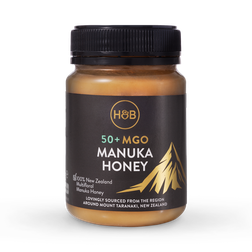
Holland & Barrett
£21.99
£10.99
£3.14/100 g
What are the potential benefits of Manuka honey?
Whether you’re searching for its new honey or you just want to upgrade your toast, you’re in luck. There's still more to learn about what Manuka might do, but we’ll go into it below...
Manuka honey may have antibacterial properties
All types of honey are known for their antibacterial properties, but Manuka honey is thought to take it to a whole new level. The special ingredient? MGO. MGO, aka methylglyoxal, is where Manuka honey gets its antibacterial properties from.2 In regular table or runny honey, its hydrogen peroxide breaks down in processing and storage, meaning a lot of the antibacterial benefits get lost. However, Manuka honey has MGO up its sleeve, so its antibacterial properties don’t just disappear even after the hydrogen peroxide has broken down.2,3
Easy ways to add Manuka honey to your diet
Manuka honey has a stronger, more complex flavour than many lighter honeys, so a little can go a long way. Manuka honey can be used just like other honeys, so it slips easily into everyday meals and snacks – no fancy prep required.
- Toast or crumpets: drizzle or spread over warm toast, sourdough or crumpets
- Porridge or overnight oats: stir through hot porridge or swirl into overnight oats for a rich, caramel-like sweetness
- Yoghurt bowls: spoon over Greek or plant-based yoghurt with fruit, seeds or granola
- Tea or warm water: add a spoonful to tea, herbal infusions or warm (not boiling) water
- Smoothies: blend a small amount into fruit or protein smoothies for extra sweetness
- Salad dressings: whisk a little into homemade dressings with olive oil, vinegar or lemon for balance
- Drizzled, not baked: many people prefer adding Manuka honey after cooking, such as over pancakes, baked fruit or porridge, to enjoy its flavour and texture
- Baking: it can be used in cakes, muffins or flapjacks and can add moisture
- Some people enjoy Manuka honey on its own, taking a small spoonful as part of their daily routine
How do I choose the right Manuka honey for me?
- Check your honey’s genuine
First things first, be sure your Manuka honey is what it says it is – there are a lot of fakes out there. Currently, all Manuka produced in New Zealand must be lab tested and pass a government-issued test.8 Check the label for a UMF (Unique Manuka Factor) trademark.2 Most genuine Manuka is packed in New Zealand, but if you’re buying Australian Manuka, check for the Australian Manuka Honey Association (AMHA) mark of authenticity on the label. All Manuka honey available at Holland & Barrett carries authenticity stamps, which shows that the honey has passed these stringent lab tests. - Decide on monofloral vs multifloral
Monofloral Manuka means that the bees have only visited the Manuka bush. This is typically regarded as a higher-quality type of Manuka. There’s also multifloral Manuka, which means that bees may have visited other types of plants, as well as the Manuka bush when making their honey. Manuka honey is rigorously tested to see if it’s monofloral or multifloral.9 Multifloral Manuka is still classed as Manuka honey, but the levels of certain chemicals are less than monofloral.9 On the other hand, multifloral Manuka is generally cheaper, so it might be right for you if you’d rather spend less. - Choose your strength
The ‘stronger’ Manuka honey is, the stronger its flavour. There are a few different ways of measuring the quality, potency and antibacterial potential of Manuka honey. The higher quality the honey, the more expensive it’ll be – so it’s up to you to decide what fits your budget. The most popular method of rating Manuka honey is MGO, but you might also see UMF or NPA ratings. Let’s go through them in more detail...
Holland & Barrett
£26.99
£13.49
£3.85/100 g
Manuka honey: decoding the ratings
What’s MGO in Manuka honey?
What sets Manuka honey apart is its naturally high levels of methylglyoxal (MGO). In most other honeys, this compound is only present in very small amounts. This naturally occurring compound develops from the nectar during honey production and maturation. The amount of MGO present can vary between batches, which is why Manuka honeys are often labelled with an MGO rating.4,5,6
The antibacterial properties of honey are provided by hydrogen peroxide. In normal table honey, the hydrogen peroxide activity breaks down, meaning the antibacterial benefits are lost. But in Manuka honey, thanks to MGO, the antibacterial properties remain even after the hydrogen peroxide has disappeared.3 Manuka honey comes in a range of MGO ratings. In general, a higher rating indicates a higher quality honey.9
Holland & Barrett
£32.99
£16.49
£4.71/100 g
What’s UMF in Manuka honey?
Some Manuka honey is graded by the UMF grading system set up by the ‘Unique Manuka Factor Honey Association’ in New Zealand. The Unique Manuka Factor looks at four main elements: potency, authenticity, shelf life and freshness.9 This involves making sure there are enough of the following chemicals: 9
- methylglyoxal (MGO): which provides Manuka’s antibacterial properties
- leptosperin: which is only found in Manuka plants and so helps to verify that the honey is true Manuka
- dihydroxyacetone (DHA): which slowly converts to MGO over time
- hydroxymethylfurfural (HMF): whose presence shows the honey has been stored correctly
The honey is then given a number rating from UMF 5+ to UMF 25+. The higher the rating, the higher quality the honey.9
What’s NPA in Manuka honey?
NPA stands for the Non-Peroxide Activity of honey, which is another way to classify its potency and quality. It measures the level of methylglyoxal the honey contains once the hydrogen peroxide has been removed.3
FAQs
It totally depends what you’re looking for in your Manuka honey. Higher MGO ratings show greater levels of this naturally occurring compound. Overall quality also depends on factors like authenticity, flavour and how the honey is produced and stored.10
At Holland & Barrett, we've simplified the Manuka honey that we sell. This means you’ll only see MGO ratings on our labels and not UMF or NPA. If you've previously bought UMF or NPA-rated Manuka honey, then here’s a simple chart that shows you the corresponding MGO level:
MGO to UMF/NPA comparison table

MGO and NPA measure slightly different things: MGO looks for the amount of methylglyoxal, while NPA measures the total antibacterial effect without hydrogen peroxide activity.
That’s for you to decide! If you want a high-quality honey you'll probably have to spend more money than you would if you went for your average run-of-the-mill table honey. Whether it’s worth the price tag is totally up to you.
Yes – try eating it straight from the jar for unrivalled freshness or mixing it into smoothies, yoghurt, cereal or salad dressings. It’s also great drizzled over pancakes or to add sweetness to mocktails.
However, if you’re taking Manuka honey for a cold and don’t fancy it à la spoon, try mixing it into hot tea with a squeeze of fresh lemon to help soothe that scratchy throat.
Most large supermarkets and health food stores will stock Manuka honey. However, if you’re looking for a range of strengths and brands to peruse, discover our Manuka honey selection here at Holland & Barrett.
The final say
No matter which kind of Manuka’s right for you, there’s a whole range of ways to enjoy your new sweet treat. Why not try our miso, honey and aubergine poke bowl or Manuka honey oats with protein nut butter? Or stock up on our top Manuka honey products...
Disclaimer – This article provides informational advice and is not a substitute for medical care. Working with experts for accuracy, we take great care to ensure the information is up-to-date and relevant. However, you should always consult your GP or healthcare professional before using supplements or alternative products, particularly if you have medical conditions or are under supervision.
1. National Cancer Institute (NIH). Manuka honey [Internet]. NIH [cited 2026 Feb 17]. Available from: https://www.cancer.gov/publications/dictionaries/cancer-drug/def/manuka-honey
2. Johnston M, McBride M, Dahiya D, Owusu-Apenten R, Singh Nigam P. Antibacterial activity of Manuka honey and its components: An overview. AIMS Microbiol [Internet]. 2018 Nov 27 [cited 2026 Feb 17]; 4(4): 655-664. Available from: https://pmc.ncbi.nlm.nih.gov/articles/PMC6613335/
3. Molan P. The use of Manuka honey to promote wound healing. L.O.G.I.C. (Linking Opportunities Generating Inter-Professional Collaboration): The Official Journal of The New Zealand College of Primary Health Care Nurses. 2013 Mar 26 [cited 2026 Feb 17]. Available from: https://www.umf.org.nz/research-database/the-use-of-manuka-honey-to-promote-wound-healing/
4. Gośliński M, Nowak D, Mindykowski R, Kulewski W, Popławski C. Application of Manuka honey in treatment patients with GERD. Food Sci Nutr. 2024 [cited 2026 Feb 17]; 12(1): 172-9. Available from: https://pubmed.ncbi.nlm.nih.gov/38268884/
5. Wang S, Qiu Y, Zhu F. An updated review of functional ingredients of Manuka honey and their value-added innovations. Food Chem. 2024 [cited 2026 Feb 17]; 440: 138060. Available from: https://pubmed.ncbi.nlm.nih.gov/38211407/
6. Nolan VC, Harrison J, Wright JEE, Cox JAG. Clinical Significance of Manuka and Medical-Grade Honey for Antibiotic-Resistant Infections: A Systematic Review. Antibiotics (Basel). 2020 [cited 2026 Feb 17]; 9(11). Available from: https://pubmed.ncbi.nlm.nih.gov/33142845/
7. Wallace A, Eady S, Miles M, Martin H, McLachlan A, Rodier M, et al. Demonstrating the safety of manuka honey UMF 20+in a human clinical trial with healthy individuals. Br J Nutr. 2010; 103(7): 1023-8. Available from: https://pubmed.ncbi.nlm.nih.gov/20064284/
8. The Ministry for Primary Industries. Manuka Honey Science Definition [Internet]. The Ministry for Primary Industries [cited 2026 Feb 17]. Available from: https://www.mpi.govt.nz/dmsdocument/17374-Manuka-Honey-Science-Definition-infographic
9. Unique Manuka Factor (UMF). The Golden Standard in Manuka Honey [Internet]. UMF [cited 2026 Feb 17]. Available from: https://www.umf.org.nz/unique-manuka-factor/
10. Green KJ, Lawag IL, Locher C, Hammer KA. Correlation of the antibacterial activity of commercial manuka and Leptospermum honeys from Australia and New Zealand with methylglyoxal content and other physicochemical characteristics. PLoS One [Internet]. 2022 Jul 28 [cited 2026 Feb 17]; 17(7). Available from: https://pmc.ncbi.nlm.nih.gov/articles/PMC9333225/
Related to this article